Good Work Doesn't Speak for Itself Anymore
We were all told the same thing: put your head down, do good work, and eventually someone will notice. That doesn't work. So we were told the opposite: get loud, get on social media, make more noise than the next person. That doesn't necessarily work either.
Feeling a tad relieved?
Neither extreme accounts for the pattern you actually have, when you're being you.
Turns out there's a third option: get seen without disappearing, and without becoming that person who drowns out everyone else.
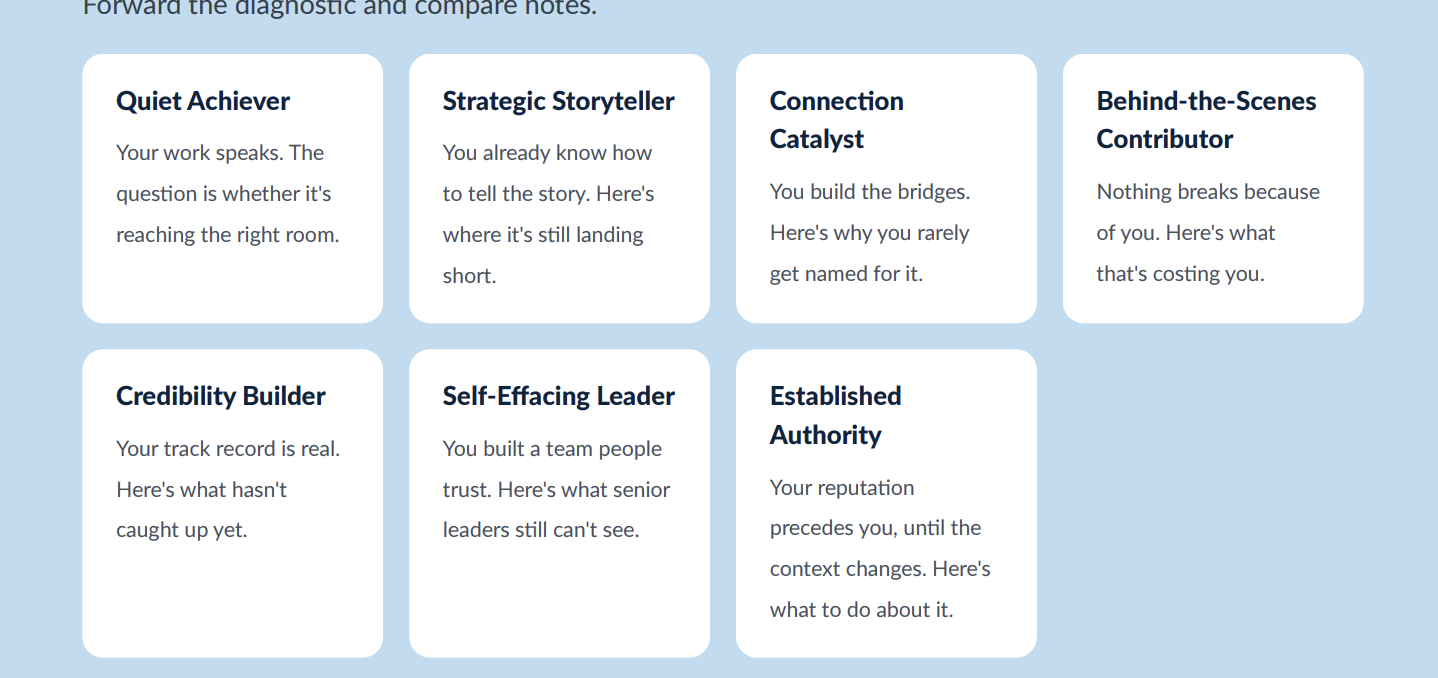
I built a six-question diagnostic with eight outcomes, one that works whether you're the most junior person in the room or the CEO. Quiet Achiever. Strategic Storyteller. Connection Catalyst. Impact Architect. Behind-the-Scenes Contributor. Credibility Builder. Self-Effacing Leader. Established Authority.
The Quiet Achiever's work is strong, but decision-makers don't promote what they can't see. The Self-Effacing Leader built the team everyone admires, and their own strategic decisions disappeared into "the team delivered." The Established Authority earned the track record and is still introduced by their past, not their next chapter.
Eight patterns, eight different costs. Generic advice was never built for any of them.
This isn't a confidence issue. It's a signal clarity issue, and it's as much a leadership issue as an individual one. Leaders can only deploy, credit, and promote what they can actually see. When a team's value stays hidden, that's lost partnerships, lost clients, lost market position, not a personality problem.
(I can hear some of you saying right now, "Lisa, there's no 'I' in team." To which I say, in my keynotes and workshops: there is in innovation, initiative, and one I think we need to talk more about, credit.)
I wrote the book on this. I still have to take a page out of it every day.
Try it on yourself first. Then run it across your team, so you know exactly who's carrying which pattern, and what to do with that.
FAQ
Is this for the person taking it, or for the leaders around them?
Both, and the leadership use may be the bigger one. For a leader, this isn't a team-building exercise. It's a fast way to see where the real impact on your team is actually coming from, so you can deploy it, credit it accurately, and act before a competitor, a client, or an exit gets there first. The diagnostic surfaces the pattern. What a leader does with that, who gets pulled into the next pitch, who gets positioned for the next stage, is where the business value actually gets captured.
Why doesn't good work get recognized on its own?
Decision-makers act on what reaches them, not on what's true. The Quiet Achiever pattern is the clearest case: the work is genuinely strong, but as the research behind this diagnostic puts it, decision-makers don't promote what they can't see. The work isn't the problem. What reaches the room is.
Does this affect teams, or just individuals?
Both, often at the same time. The Self-Effacing Leader pattern shows it directly: a leader builds a team everyone admires, and the decisions that built it disappear into "the team delivered." Years later, they're being evaluated on outcomes they can no longer claim as their own.
What does it cost an organization when this goes unaddressed?
Gallup puts the global figure at nearly $101trillion in lost productivity when expertise inside organizations never translates into visible, actionable impact. That's not a motivation problem. It's a translation problem, between what's actually happening inside a company and what the people deciding its future can see.
What you get at the end of the diagnostic isn't a personality test. It's proof the advice, "put your head down" or "get loud on social," was one-size-fits-all from the start. What you get instead are the strategic moves built for the pattern that's actually yours.
Try it, share it, and let me know your results.