The Speed of Opportunity: Why "Invisible Expertise" is a $9.6 Trillion Problem
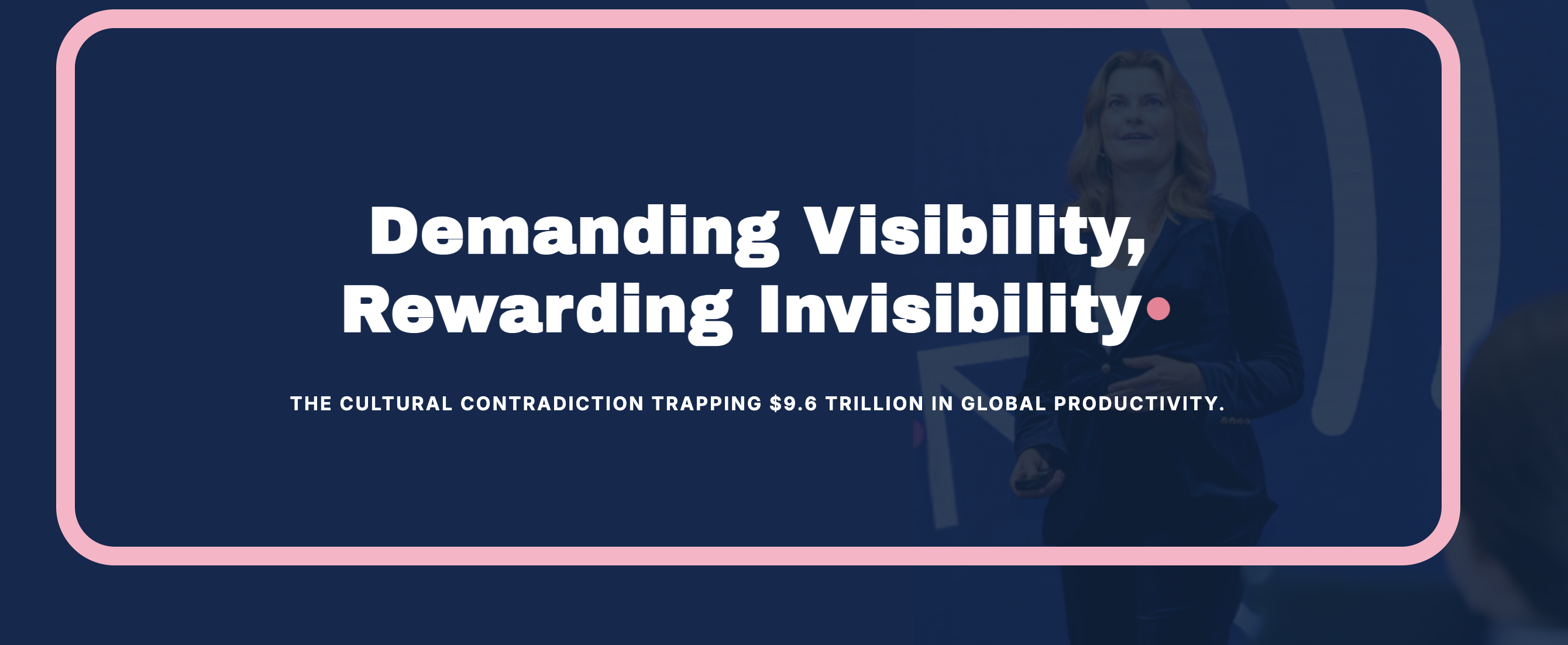
Organizations are demanding what they've made structurally impossible: individual impact articulation from people who were trained to disappear at the exact moment they should be most visible.
"Scarily relevant."
That's what a mentee recently said about the message in Bragging Rights. It took a beat for me to register what she meant: the book was written for exactly these times.
I recently saw what my friend Liane Davey flagged: Fortune reporting that CEOs at Amazon, Meta, and Citi are now demanding employees prove their impact with specific accomplishments. Amazon, for example, is asking for "three to five accomplishments that show the impact of your work."
The Modern Contradiction
Organizations want measurable impact from individuals. Meanwhile, we're still telling people there's no 'I' in team—demanding visibility while culturally reinforcing invisibility.
As I share in my keynotes: "We’ve been told for decades there is no I in team. We forgot there is an I in Impact, an I in Innovation, and most importantly, an I in Credit."
With AI and algorithms increasingly determining who gets seen and heard, you can't wait for someone to stumble across your expertise. In an automated world, human visibility is your only competitive advantage. The power dynamics are shifting faster than most organizations realize.
The $9.6 Trillion Stake
Gallup shows the stakes: if the world's workplace was fully engaged, $9.6 trillion in productivity could be added to the global economy. That's 9% of global GDP.
That value is not trapped behind a lack of effort. It's trapped behind invisible expertise that decision-makers simply can't see.
Opportunities move at speeds that don't wait for permission. When your people can't communicate their expertise quickly and confidently, you miss client wins, strategic partnerships, and market positioning moments that won't wait for quarterly reviews.
This isn't about becoming competitive in ways that make you irreplaceable. It's about making sure there's a "yes, and" to sharing successes so the whole team's value becomes visible to the stakeholders who control resources, opportunities, and recognition.
Moving at the Speed of Opportunity
To capture that $9.6 trillion in trapped productivity, we have to move on three levels:
- For the Individual: Don't wait for your boss to ask for three accomplishments. Start building the muscle now.
- For the Team: Create a "yes, and" culture where one person’s win is seen as the fuel for the group’s momentum.
- For the Organization: Stop demanding visibility while culturally reinforcing invisibility. If your people haven't been given the tools to articulate their value, your ROI stays invisible.
Is your organization's culture of "modesty" actually a bottleneck for your growth?
Strategic Visibility: Frequently Asked Questions
How can I articulate my individual impact without sounding arrogant?Shift the focus from ego to evidence. Bragging isn't about inflation; it's about accurate reporting. When you describe your work in terms of the "needle moved" for the company, you aren't self-promoting—you are providing the data leadership needs to make better decisions.
How do we foster a "yes, and" culture within a team?Visibility is not a zero-sum game. Leaders must model that when one person’s expertise is highlighted, it raises the "market value" of the entire team. By acknowledging individual wins publicly, you create a roadmap for others to follow, turning silos into a collective engine of success.
Why is "invisible expertise" a risk for the organization?Invisibility is a business risk. If leadership doesn't know where the expertise lives, they cannot deploy it effectively. When you train your people to articulate their impact, you unlock trapped productivity and ensure the organization can move fast enough to capture market opportunities that won't wait for quarterly reviews.