The Words That Win: How to Articulate Value Without Sounding Arrogant
Knowing which words create opportunities and which close doors before you're in the room: that's the difference between being good at what you do and being known for it.
If you've ever wondered how to talk about your accomplishments without feeling awkward, the answer isn't working harder. It's speaking more strategically.
The Pattern No One has Named
I've studied more than 400 professionals across 23 countries. High-performers don't work harder. They speak differently. They've learned which words open doors and which words close them. The cost of getting this wrong:
- 85% fear appearing obnoxious when self-promoting.
- 70% miss opportunities because they can't articulate their value.
- 70% would rather quit than self-advocate.
We're trained to disappear at the exact moment we should be most visible.
The Words That Lose
When you use these patterns, you aren't being "modest." You're signaling to the organization that you aren't ready to lead high-stakes initiatives.
- Humblebragging: "I'm so exhausted from last night's awards ceremony. So humbled they picked me."
- The Signal: You prioritize ego-validation over results. Leadership sees a performer, not a partner. (Research also shows people don't like humblebragging)
- The Minimizers: "Just helped with..." / "Only contributed to..."
- The Signal: You were a passenger, not a driver. Decision-makers stop looking to you for direction.
- Passive Voice: "It was decided..." / "The target was missed..."
- The Signal: You are an observer of your own work. It suggests a lack of accountability.
- Vague Corporate-Speak: "Involved in" / "Participated in"
- The Signal: You are overhead, not an asset. Support staff are replaceable; strategic drivers are not.
- Fake Modesty: "It was really a team effort."
- The Signal: You can't isolate where value was created. If you can't explain the "how," leadership can't replicate the success. (While there's no "i" in team, there is an "i" in credit.)
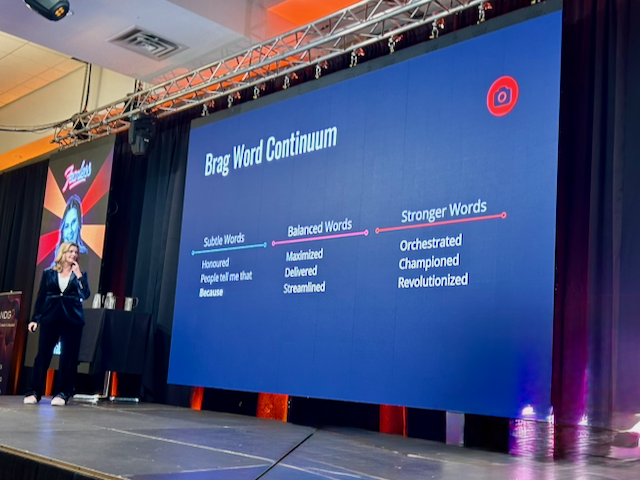
The Brag Word Continuum
Strategic leaders adapt their language to the stakes. They operate in three zones of intensity:
Subtle (Use in: Team settings, building trust)
"I partnered with operations to cut the approval bottleneck in half."
Balanced (Use in: Peer discussions, professional profiles)
"I redesigned the workflow and reduced approval time by 50%."
Strong (Use in: Executive meetings, high-stakes negotiations)
"I led the operational overhaul that delivered $2 million in annual savings."
The question isn't which version is "correct." The question is: Which version matches the stakes of the room?
Your First Win: The "Because" Bridge
Want to shift from Subtle to Balanced right now? Add one word: "because." This word forces you to connect your action to proof and scales from the front line to the C-Suite.
The Operational "Because"
- Before: "I helped the team meet the deadline."
- After: "I helped the team meet the deadline because I restructured the workflow to eliminate three approval steps."
The CEO-Level "Because"
- Before: "We hit our growth target."
- After: "We hit our growth target because I reallocated $2 million from underperforming legacy channels into the high-growth digital segment."
The "Because" Bridge moves you up the Continuum without feeling unnatural. It shifts the conversation from what you did to the leverage you created.
Why This Matters
Organizations are losing $9.6 trillion globally because valuable expertise stays invisible (Gallup). When you match your language to the context, you stop being "the person who does the work" and start being the person who drives the opportunity.
The Continuum is learnable. Context awareness is trainable. You can't see your own blind spots any more than you can hear your own accent. Strategic visibility isn't a solo project. It's organizational infrastructure.
Visibility isn't about being louder. It's about being clearer. Clarity is learnable.
Bring Bragging Rights to Your Organization
When high performers can’t articulate their value, the organization loses its competitive edge. Based on the research in my book, Bragging Rights: How to Talk about Your Work Using Purposeful Self-Promotion, I help global teams bridge the gap between "doing the work" and "driving the opportunity."
Strategic Visibility: Frequently Asked Questions
How do you articulate value without sounding arrogant?
Arrogance is a failure of context, not a result of sharing your success. It happens when you use "Strong" language in a "Subtle" setting. By using the Brag Word Continuum, you learn to calibrate your intensity to the room. When your language matches the strategic stakes, you aren’t being arrogant—you’re providing the organization with the clarity it needs to make better decisions.
Why does "good work" go unnoticed in large organizations?
Organizations operate on signals. If you use "Subtle" language in "Strong" contexts—like boardrooms or high-stakes briefings—you signal that you are a passenger rather than a driver of strategic opportunity. High-performers don't get recognized for their effort; they get recognized for their ability to articulate their impact.
What is the $9.6 Trillion productivity gap?
According to Gallup, global productivity loses trillions when valuable expertise stays invisible. Strategic visibility isn't a "soft skill"; it is organizational infrastructure. When expertise is hidden behind minimizers and vague corporate-speak, the best ideas and people remain underutilized.